

flatten-mcp
★ 3from shayaShav
Flatten Claude Code sessions: keep every prompt and event verbatim, resume at a lower token count.

flatten-mcp
Move the bulk out of a Claude Code session — the huge file reads, logs, and screenshots the model already digested — into a local backup, fully reversibly. On Pro/Max that means compaction fires later and the model stays sharp; on API billing it means paying for fewer tokens. Every prompt and event stays verbatim.

340,071 → 132,800 tokens — a 61% lighter session, every line of history intact.
macOS · Linux · WSL2 — native Windows untested
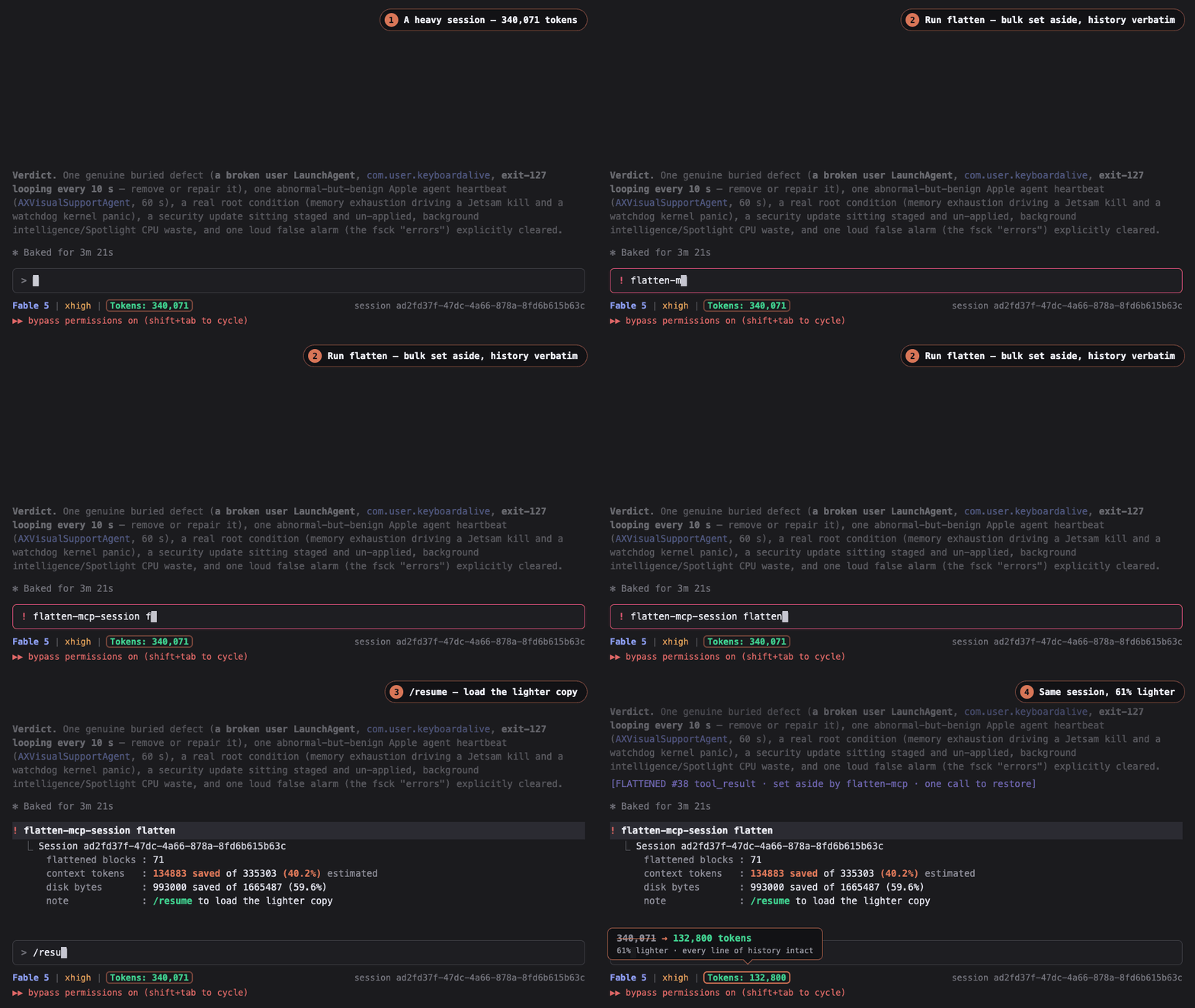
Most of a long session's tokens are raw source the model already distilled into prose —
the 2 MB log it boiled down to one line, the screenshot it described, the five files it
summarized. flatten-mcp moves that bulk into a local backup next to the session and leaves
a small [FLATTENED …] marker in its place. Nothing is rewritten, nothing is summarized
away; any block is one call from coming back. The whole thing is a handful of small
TypeScript files with two direct dependencies — small enough to audit in one sitting.
/compact | Auto tool-result clearing | flatten-mcp | |
|---|---|---|---|
| What happens | history rewritten into a summary | old tool results cleared as the limit nears | bulk moved to a local backup, markers remain |
| Lossy? | yes — an interpretation | cleared content is gone from context | no — byte-identical restore any time |
| You choose when? | you or the auto-cliff | automatic | yes |
| Session file on disk | rewritten | unchanged | shrinks; the backup keeps every original |
Taste it first — nothing installed, nothing written:
npx -y flatten-mcp-session flatten --dry-runRun it from a project you use Claude Code in: it prints the exact savings a flatten would give your most recent session and writes nothing.
What you'll actually save
The reduction is the bulk you remove, not a fixed percentage:
- Read-heavy sessions (large files, long logs, screenshots): the demo above measured 340,071 → 132,800 tokens, a 61% cut. The more ingested bulk, the bigger the cut — base64-screenshot-heavy sessions can go higher.
- Prose-heavy sessions (little external data): savings are small — there's not much bulk to move.
A common point to reach for it is around 200k tokens; the most dramatic cuts show up at 250k–400k. It's repeatable — a re-flatten only touches bulk that arrived since the last one. The three tool schemas cost ~1,200 tokens per turn while the server is connected; one flatten of a read-heavy session removes orders of magnitude more from every later turn (207k in the demo), and the separate-window pattern above makes even that overhead zero.
Tools
| Tool | What it does |
|---|---|
flatten_session | Move bulky tool results into the backup, leaving [FLATTENED …] markers. Crash-safe, reversible. No argument = current session; supports dry_run, min_size, include_tool_use_result. |
retrieve_flattened | Fetch one original block back by id — text, or a flattened screenshot re-rendered as a real image. |
unflatten_session | Reverse everything: re-inline every block from the backup, then delete the backup. |
In a flattened session the model sees markers like this, carrying everything needed to fetch the original:
[FLATTENED id=toolu_01AbC… tool=Read file_path=/src/server.ts | text 48213B/612L | session=2f9c… | retrieve_flattened(id,session) for raw content]How it works
- One backup, not deletion.
<session>.jsonl.bakholds the complete session fully inlined; the live file carries markers. Kept in lockstep every run (backup = unflatten(live),live = flatten(backup)). - Crash-safe. Originals are written to the backup before bulk leaves the session, each write via atomic temp-file-and-rename — an interrupted run can't leave a half-written session.
- Self-cleaning. A full unflatten restores everything inline and deletes the backup — zero artifacts left.
- Re-flatten friendly. As the session grows, run it again; only new bulk is touched, and content added after a flatten is never lost on restore.
- Lossless. Text and base64 images are stored exactly as they appeared —
unflatten_sessionrestores byte-identical values. - Honest numbers. Claude Code stores each tool result twice on disk but sends one to
the model; reports separate
diskBytesSavedfromcontextTokensSaved(the number that matters), estimated locally — or exact viacount_tokenswhen you opt in withFLATTEN_COUNT_EXACT=1(plusANTHROPIC_API_KEY).
Details — session JSONL format, backup model, marker protocol — in docs/ARCHITECTURE.md.
Validate the claims yourself: (1) pick a meaty session; (2) ask for a dry run and read
the report; (3) /flatten for real, /resume, and watch the context indicator drop by the
reported amount; (4) diff <session>.jsonl.bak against a pre-flatten copy if you kept one,
then unflatten and confirm the restore is byte-identical.
Security & verification
- Provenance you can check. Every release is published from CI via npm trusted
publishing (OIDC) with provenance attestations, from a signed tag — no npm
token exists anywhere. Verify:
npm audit signatures. Pin an exact version (as the Quick start does) and the committedpackage-lock.jsondocuments the tree we test against;npxresolves the two direct dependencies' own trees at install time — audit withnpm ls --omit=dev. - File access. Confined to the session store,
<CLAUDE_CONFIG_DIR or ~/.claude>/projects/<encoded-project-dir>/— rewriting session files there is the tool's entire job, always backup-first and atomic. The one exception:flatten-mcp-session retrieve --outwrites a retrieved image where you tell it to. - Network. Zero outbound calls unless you explicitly opt in to exact token counts.
With both
FLATTEN_COUNT_EXACT=1andANTHROPIC_API_KEYset — key presence alone is not enough — exactly one endpoint is ever contacted:POST api.anthropic.com/v1/messages/count_tokens(free). The request body contains the counting model id (FLATTEN_COUNT_MODEL) and a single user message holding the tool results being flattened, reduced to their text and image blocks; a second identical call counts the replacement markers. Sent only to Anthropic; the key is read from the environment and never stored or logged. There is no other outbound URL in the codebase. The optionalflatten-mcp-httpbin (below) accepts inbound connections when you run it — localhost by default — and makes no outbound calls. - No telemetry, no shell, no hooks. No analytics, no spawned processes, no permission bypasses. Vulnerability reports: SECURITY.md.
Beyond Claude Code — CLI & library
The same engine ships as a terminal CLI, an in-memory library, and a Streamable HTTP server, so raw Messages API callers (any language) get the identical flatten/unflatten semantics with no MCP and no session files.
flatten-mcp-session — flatten Claude Code sessions from the terminal (no LLM turn, zero tokens)
npx -y flatten-mcp-session flatten                     # most-recent session in this project
npx -y flatten-mcp-session flatten <session> --dry-run
npx -y flatten-mcp-session list
npx -y flatten-mcp-session unflatten <session>
npx -y flatten-mcp-session retrieve <session> <tool_use_id> --out shot.png<session>: UUID,last,"last N",current, or a keyword — same grammar as the MCP tool. Shared flags:--project-dir,--claude-dir,--json.- Drives the exact same on-disk engine as the MCP server — ideal for cron and scripts.
After a real flatten,
/resumethe session in Claude Code to load the lighter copy.
flatten-mcp-cli — flatten a raw Messages API conversation over stdin/stdout
echo '[{"role":"user","content":"hi"}]' | npx -y flatten-mcp-cli --flatten
npx -y flatten-mcp-cli --flatten --min-size 2000 < body.json > flattened.json
npx -y flatten-mcp-cli --unflatten < flattened.json > restored.json--flattenprints{ messages, extracted, flattenedCount, contextTokensSaved, … }— persistextractedyourself; you are the store.--unflattenrestores byte-for-byte. No server, no disk, no network. Bad input → stderr + exit 1.
Library API — flattenMessages / unflattenMessages in-memory
import { flattenMessages, unflattenMessages } from 'flatten-mcp';

const { messages, extracted, contextTokensSaved } = flattenMessages(myMessages);
// send `messages` to the API; persist `extracted` yourself — you are the store.
const original = unflattenMessages(messages, extracted); // byte-for-byte restore- Synchronous, never mutates input (deep-copies first).
flattenRequestBody/unflattenRequestBodyhandle a full{ system, messages, tools, … }body. - Exact token counts (optional, async):
flattenMessagesExactuses Anthropic's freecount_tokenswhenANTHROPIC_API_KEYis set — calling the*Exactvariant is the opt-in here (countExact: falseforces the estimate); theFLATTEN_COUNT_EXACTvariable gates only the MCP server and session CLI. - Prompt-caching caveat: flattening earlier messages changes the cached prefix and
invalidates
cache_controlbreakpoints from that point on — flatten before establishing a breakpoint, or the cache re-write can cost more than the flatten saves in short-lived conversations.
flatten-mcp-http — the in-memory engine over MCP Streamable HTTP
npx -y flatten-mcp-http            # POST http://127.0.0.1:8787/mcp
npx -y flatten-mcp-http --port 3000 --host 0.0.0.0- Serves
flatten_messages/unflatten_messages— the same stateless in-memory engine as the library, callable from any MCP client or hosted registry inspector. Persist the returnedextractedyourself and feed it back to restore, exactly like the library. - The three disk tools are not exposed over HTTP: they operate on the local Claude
Code session store, which does not exist wherever a remote client calls from. (On the
stdio server,
FLATTEN_INMEMORY_TOOLS=1adds these two tools alongside the disk ones.) - No auth, permissive CORS, no outbound network calls — the tools are pure functions
over the request's JSON. Binds
127.0.0.1by default; put your own proxy/auth in front before exposing it further. Note the transport cost: the conversation you flatten travels to this server and back — inside your own process, prefer the library.
Compatibility & roadmap
- Claude Code's session store only, for now — the paths and JSONL schema are specific to it. WSL2 counts as Linux: if your Claude Code runs inside WSL2, flatten-mcp runs in the same environment and targets those sessions normally. Native Windows is untested.
- The CLI and library above are the first adapter over the shared block logic; porting to other agents means abstracting the storage seam — contributions welcome (CONTRIBUTING.md).
npx -y -p flatten-mcp flatten-mcp-session flatten --dry-runBefore it works, you'll need: ANTHROPIC_API_KEYANTHROPIC_API_KEYANTHROPIC_API_KEY
Quick start
Runs through npx — no global install, nothing added to your project. Every read/write
stays inside Claude Code's own session store under ~/.claude/projects/, and there are
zero network calls by default. (Node ≥ 18, which Claude Code already runs on.)
1. Install — either path:
# Terminal: register the server user-wide (pinned; use @latest if you prefer auto-updates)
claude mcp add flatten -s user -- npx -y flatten-mcp@2.2.0

# Optional: the /flatten slash command
curl -fsSL https://raw.githubusercontent.com/shayaShav/flatten-mcp/main/commands/flatten.md -o ~/.claude/commands/flatten.md# Or as a Claude Code plugin — registers the server AND bundles /flatten in one step
claude plugin marketplace add shayaShav/flatten-mcp
claude plugin install flatten-mcp@flatten-mcp2. Restart Claude Code (or open a new session) — an already-open session does not pick
up a newly added server. Check with /mcp: flatten should be listed as connected.
3. Use it — two steps, always:
/flatten     → the session file is rewritten in place (a complete backup is written FIRST — nothing is ever lost)
/resume      → switch to another session and back; the reloaded copy is the lighter one
Until you /resume, the window you are in still holds the full pre-flatten copy in memory —
nothing will look different. After it, watch the context indicator drop.
Manual registration / from source
In ~/.claude.json or your project's .mcp.json:
{
    "mcpServers": {
        "flatten": { "command": "npx", "args": ["-y", "flatten-mcp@2.2.0"] }
    }
}
For development: git clone https://github.com/shayaShav/flatten-mcp.git && cd flatten-mcp && npm install, then point the config at node /absolute/path/to/dist/index.js.
Usage
- Bare
/flatten(or asking "flatten this session") targets the current session — the server identifies it fromCLAUDE_CODE_SESSION_ID. Pass a UUID to target another session. - Preview first with a dry run — "dry-run flatten this session" — nothing is written.
- Undo completely by asking to unflatten: every block returns to its exact original value.
- Don't flatten a session that is mid-generation; flatten between turns, or from a second window — which also keeps the tool schemas out of your working session entirely.
[!TIP] Flattening is pure file surgery — no model intelligence involved — so a fast, inexpensive model (
/model haiku) flattens just as well as a frontier one.
Configuration
Operates on the project the CLI runs in; pass project_dir on any call to target another.
| Env var | Required | Purpose |
|---|---|---|
CLAUDE_CONFIG_DIR | no | Claude config dir whose projects/ store is read (default ~/.claude). Same variable Claude Code uses for profiles, so an alternate-profile server targets its own sessions automatically; override per call with claude_dir. |
FLATTEN_COUNT_EXACT | no | Set to 1 to count token savings exactly via Anthropic's free count_tokens — the only outbound call, and it needs ANTHROPIC_API_KEY too. Off by default: key presence alone never triggers the request (see Security). |
ANTHROPIC_API_KEY | no | The key for the exact count. Ignored by the MCP server and session CLI unless FLATTEN_COUNT_EXACT=1. |
FLATTEN_COUNT_MODEL | no | Model id for the exact count (default claude-haiku-4-5-20251001). |
FLATTEN_INMEMORY_TOOLS | no | Set to 1 to also register flatten_messages/unflatten_messages on the stdio server (see the HTTP section above). Off by default to keep the local tool surface lean. |
Uninstall
Unflatten anything you want back inline first — a flattened session needs its
<session>.jsonl.bak for retrieve_flattened/unflatten_session, and uninstalling does
not remove backups. Then:
claude mcp remove flatten -s user && rm -f ~/.claude/commands/flatten.md   # terminal install
claude plugin uninstall flatten-mcp                                        # plugin install
To reclaim disk for sessions you'll never restore, delete their .jsonl.bak files from
~/.claude/projects/<encoded-project-dir>/.
FAQ
Won't Anthropic just build this in? Claude Code already clears old tool results
automatically near the limit (see the table up top). Flatten is a different contract:
you pick the moment, the restore is byte-identical, and the on-disk session you
/resume from actually shrinks.
Will the model fetch a flattened block, or hallucinate around it? Each marker carries
the id and session, and in practice the model calls retrieve_flattened when it needs raw
bytes back. Deterministic recovery is always there regardless: unflatten_session
re-inlines everything.
Does it need Node in my project? No — it runs through npx ephemerally and touches
only Claude Code's files, not your project or toolchain.
Can a team use it? It's per-developer (each dev's local session store). Standardize by
committing the mcpServers block to your project's .mcp.json, or point the team at the
plugin install.
Licensed under MIT— you can use, modify, and redistribute it under that license's terms.
License
MIT © Shaya Shaviv