

LINE Bot MCP Server (with SSE Support)
Model Context Protocol (MCP) server implementation that integrates the LINE Messaging API to connect an AI Agent to the LINE Official Account.
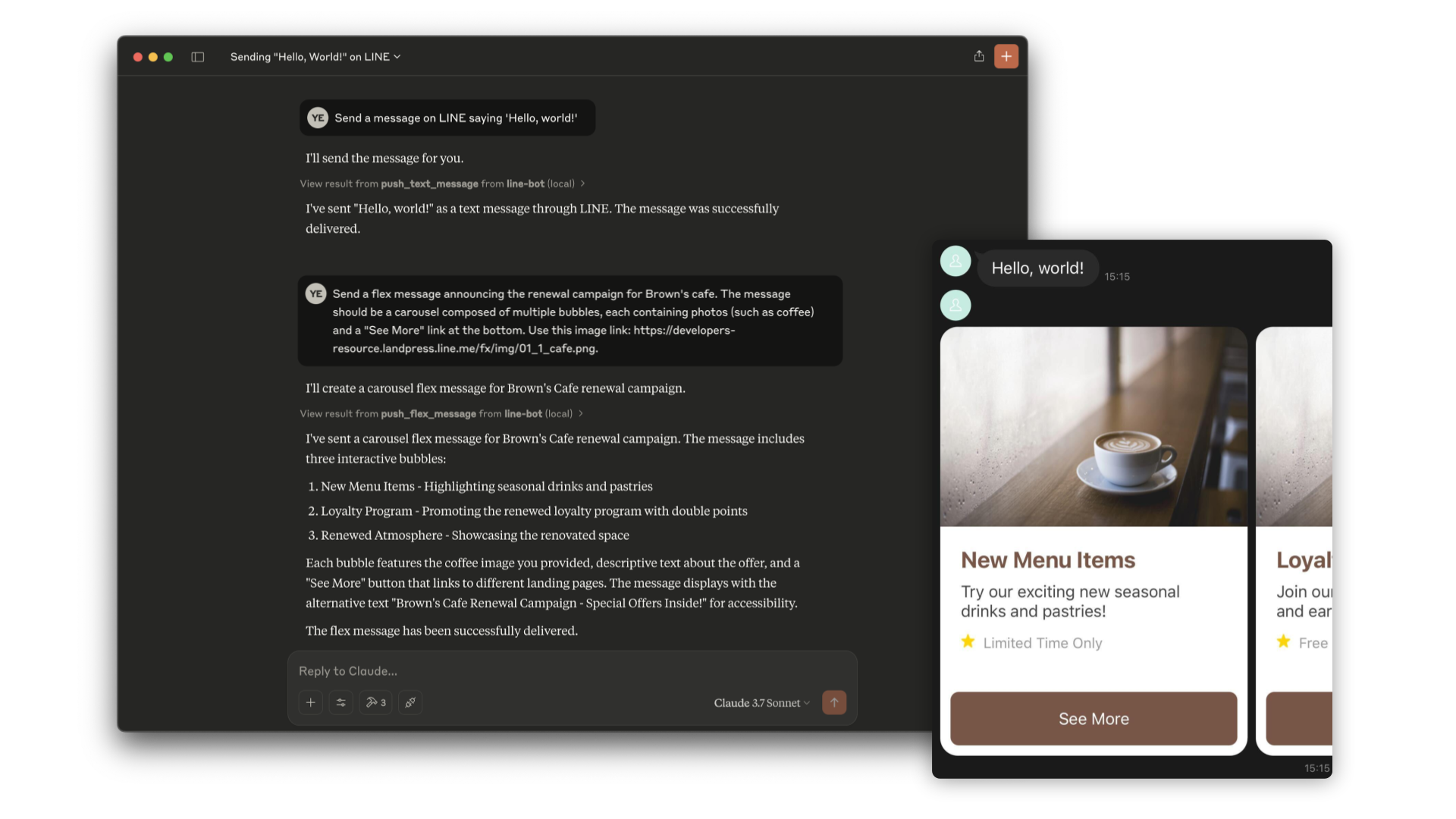
[!NOTE] This repository is a fork of the official LINE Bot MCP Server with additional SSE (Server-Sent Events) transport support. The original repository only supports stdio transport.
🔄 Fork Information
- Original Repository: line/line-bot-mcp-server
- Fork Enhancement: Added SSE transport support for web-based integrations
- Docker Image: Available on Docker Hub as
acquojp/line-bot-mcp-server-sse:latest
[!NOTE] This repository is provided as a preview version. While we offer it for experimental purposes, please be aware that it may not include complete functionality or comprehensive support.
Transport Support
This MCP server supports multiple transport protocols:
- stdio (default): Standard input/output for local integrations
- SSE: Server-Sent Events over HTTP for web-based integrations
Tools
- push_text_message
- Push a simple text message to a user via LINE.
- Inputs:
user_id(string?): The user ID to receive a message. Defaults to DESTINATION_USER_ID. Eitheruser_idorDESTINATION_USER_IDmust be set.message.text(string): The plain text content to send to the user.
- push_flex_message
- Push a highly customizable flex message to a user via LINE.
- Inputs:
user_id(string?): The user ID to receive a message. Defaults to DESTINATION_USER_ID. Eitheruser_idorDESTINATION_USER_IDmust be set.message.altText(string): Alternative text shown when flex message cannot be displayed.message.content(any): The content of the flex message. This is a JSON object that defines the layout and components of the message.message.contents.type(enum): Type of the container. 'bubble' for single container, 'carousel' for multiple swipeable bubbles.
- broadcast_text_message
- Broadcast a simple text message via LINE to all users who have followed your LINE Official Account.
- Inputs:
message.text(string): The plain text content to send to the users.
- broadcast_flex_message
- Broadcast a highly customizable flex message via LINE to all users who have added your LINE Official Account.
- Inputs:
message.altText(string): Alternative text shown when flex message cannot be displayed.message.content(any): The content of the flex message. This is a JSON object that defines the layout and components of the message.message.contents.type(enum): Type of the container. 'bubble' for single container, 'carousel' for multiple swipeable bubbles.
- get_profile
- Get detailed profile information of a LINE user including display name, profile picture URL, status message and language.
- Inputs:
user_id(string?): The ID of the user whose profile you want to retrieve. Defaults to DESTINATION_USER_ID.
- get_message_quota
- Get the message quota and consumption of the LINE Official Account. This shows the monthly message limit and current usage.
- Inputs:
- None
- get_rich_menu_list
- Get the list of rich menus associated with your LINE Official Account.
- Inputs:
- None
- delete_rich_menu
- Delete a rich menu from your LINE Official Account.
- Inputs:
richMenuId(string): The ID of the rich menu to delete.
- set_rich_menu_default
- Set a rich menu as the default rich menu.
- Inputs:
richMenuId(string): The ID of the rich menu to set as default.
- cancel_rich_menu_default
- Cancel the default rich menu.
- Inputs:
- None
Versioning
This project respects semantic versioning
Fork Information & Differences
This repository is a fork of the official LINE Bot MCP Server with the following enhancements:
✨ Added Features
- SSE (Server-Sent Events) Transport Support: Enables web-based integrations and HTTP connections
- Multi-Transport Architecture: Supports both stdio (original) and SSE transports
- Docker Hub Distribution: Pre-built Docker images available for easy deployment
- Production-Ready Configuration: Optimized for both development and production environments
🔄 Transport Comparison
| Feature | stdio (Original) | SSE (Added) |
|---|---|---|
| Use Case | Local CLI tools, direct process communication | Web applications, HTTP-based integrations |
| Connection | Standard input/output streams | HTTP + Server-Sent Events |
| Deployment | Process-based | Server-based (HTTP) |
| Port | Not required | Requires port (default: 3000) |
| Scalability | Single process | Multiple concurrent connections |
🐳 Docker Hub
- Repository:
acquojp/line-bot-mcp-server-sse - Architecture: AMD64 (x86_64) - optimized for most cloud platforms
- Tags:
latest,v1.0.0,amd64,arm64
# Pull the latest image
docker pull acquojp/line-bot-mcp-server-sse:latest

# Run directly
docker run --rm -p 3000:3000 \
 -e CHANNEL_ACCESS_TOKEN="your_token" \
 -e DESTINATION_USER_ID="your_user_id" \
 acquojp/line-bot-mcp-server-sse:latest
Before it works, you'll need: CHANNEL_ACCESS_TOKENDESTINATION_USER_ID
Installation (Using npx)
requirements:
- Node.js v20 or later
Step 1: Create LINE Official Account
This MCP server utilizes a LINE Official Account. If you do not have one, please create it by following this instructions.
If you have a LINE Official Account, enable the Messaging API for your LINE Official Account by following this instructions.
Step 2: Configure AI Agent
Please add the following configuration for an AI Agent like Claude Desktop or Cline.
Set the environment variables or arguments as follows:
CHANNEL_ACCESS_TOKEN: (required) Channel Access Token. You can confirm this by following this instructions.DESTINATION_USER_ID: (optional) The default user ID of the recipient. If the Tool's input does not includeuser_id,DESTINATION_USER_IDis required. You can confirm this by following this instructions.MCP_TRANSPORT: (optional) Transport protocol to use. Options:stdio(default),sseMCP_PORT: (optional) Port for SSE transport. Default:3000
Using stdio transport (default)
{
  "mcpServers": {
    "line-bot": {
      "command": "npx",
      "args": [
        "@line/line-bot-mcp-server"
      ],
      "env": {
        "CHANNEL_ACCESS_TOKEN" : "FILL_HERE",
        "DESTINATION_USER_ID" : "FILL_HERE"
      }
    }
  }
}
Using SSE transport
{
  "mcpServers": {
    "line-bot": {
      "command": "npx",
      "args": [
        "@line/line-bot-mcp-server"
      ],
      "env": {
        "CHANNEL_ACCESS_TOKEN" : "FILL_HERE",
        "DESTINATION_USER_ID" : "FILL_HERE",
        "MCP_TRANSPORT" : "sse",
        "MCP_PORT" : "3000"
      }
    }
  }
}
For SSE transport, the server will start an HTTP server with the following endpoints:
GET /sse- Establish SSE connectionPOST /messages- Send messages to the serverGET /health- Health check endpoint
Installation (Using Docker)
Option A: Use Pre-built Docker Image (Recommended)
You can use the pre-built Docker image from Docker Hub without building locally:
# Pull the latest image
docker pull acquojp/line-bot-mcp-server-sse:latest

# Run directly
docker run --rm -p 3000:3000 \
  -e CHANNEL_ACCESS_TOKEN="your_token" \
  -e DESTINATION_USER_ID="your_user_id" \
  acquojp/line-bot-mcp-server-sse:latest
Option B: Build from Source
Step 1: Create LINE Official Account
This MCP server utilizes a LINE Official Account. If you do not have one, please create it by following this instructions.
If you have a LINE Official Account, enable the Messaging API for your LINE Official Account by following this instructions.
Step 2: Build line-bot-mcp-server image
Clone this repository:
git clone https://github.com/your-username/line-bot-mcp-server.gitBuild the Docker image:
docker build -t line-bot-mcp-server-sse .Step 3: Configure AI Agent
Please add the following configuration for an AI Agent like Claude Desktop or Cline.
Set the environment variables or arguments as follows:
mcpServers.args: (required) The path toline-bot-mcp-server.CHANNEL_ACCESS_TOKEN: (required) Channel Access Token. You can confirm this by following this instructions.DESTINATION_USER_ID: (optional) The default user ID of the recipient. If the Tool's input does not includeuser_id,DESTINATION_USER_IDis required. You can confirm this by following this instructions.MCP_TRANSPORT: (optional) Transport protocol to use. Options:stdio(default),sseMCP_PORT: (optional) Port for SSE transport. Default:3000
Using SSE transport (default) - Docker Hub Image
{
  "mcpServers": {
    "line-bot": {
      "command": "docker",
      "args": [
        "run",
        "-i",
        "--rm",
        "-p",
        "3000:3000",
        "-e",
        "CHANNEL_ACCESS_TOKEN",
        "-e",
        "DESTINATION_USER_ID",
        "acquojp/line-bot-mcp-server-sse:latest"
      ],
      "env": {
        "CHANNEL_ACCESS_TOKEN" : "FILL_HERE",
        "DESTINATION_USER_ID" : "FILL_HERE"
      }
    }
  }
}
Using stdio transport - Docker Hub Image
{
  "mcpServers": {
    "line-bot": {
      "command": "docker",
      "args": [
        "run",
        "-i",
        "--rm",
        "-e",
        "CHANNEL_ACCESS_TOKEN",
        "-e",
        "DESTINATION_USER_ID",
        "-e",
        "MCP_TRANSPORT",
        "acquojp/line-bot-mcp-server-sse:latest"
      ],
      "env": {
        "CHANNEL_ACCESS_TOKEN" : "FILL_HERE",
        "DESTINATION_USER_ID" : "FILL_HERE",
        "MCP_TRANSPORT" : "stdio"
      }
    }
  }
}
No common issues documented yet. If you hit a problem, the repository's GitHub Issues page is the best place to look.
Licensed under Apache-2.0— you can use, modify, and redistribute it under that license's terms.
View the full license file on GitHub →